The build date is hidden in the serial number on the equipment's rating plate. Most brands put the year and the month or week in the first four characters, but each brand uses its own code. Choose your brand below and enter the serial to get the manufacture date and age. Many plates also print the date directly.
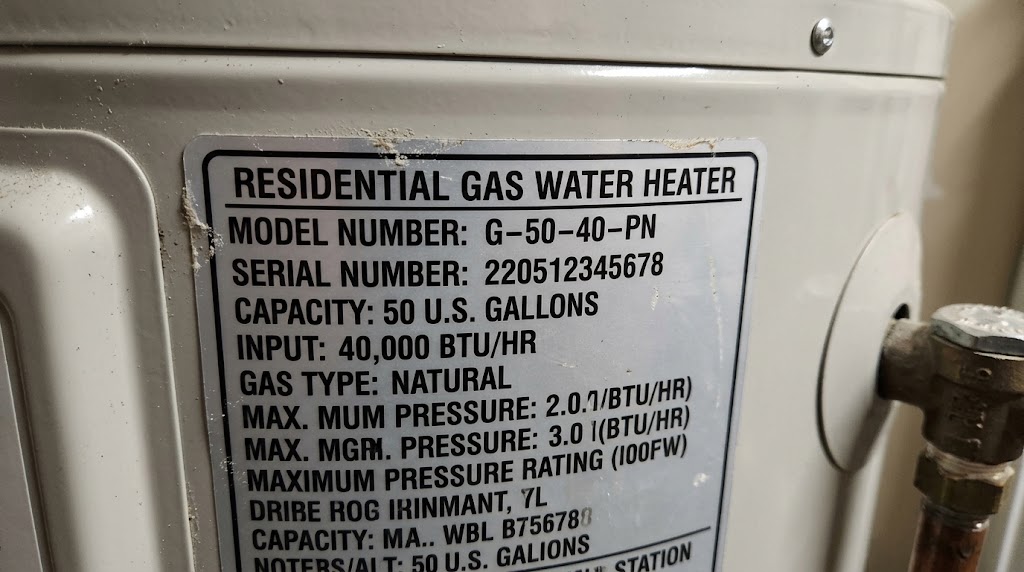
Copy the serial exactly, letters and all. The model number is a different line on the same plate; it tells you what the unit is, while the serial tells you when it was built.
There is no industry standard. Each manufacturer uses its own code, which is why the same four digits mean different things on different brands. Where a brand uses month letters, A is January through M for December, with I skipped.
| Brand | Where the date is | Example |
|---|---|---|
| Rheem / Ruud / Richmond water heaters | First four digits after any letters: month, then year (MMYY) | RH 0806B17262 = August 2006 |
| A.O. Smith / State / Reliance | First four digits: year, then week (YYWW) | 1210A002243 = week 10 of 2012 |
| Bradford White | First letter = year, second letter = month. The letters repeat every 20 years. | NH12345678 = August 2016 |
| Carrier / Bryant / Payne / Day & Night | First four digits: week, then year (WWYY) | 4006A17330 = week 40 of 2006 |
| Trane / American Standard | Since 2010: year, then week (YYWW). 2002–2009: nine characters, year digit then week. | 130313596L = week 3 of 2013 |
| Lennox / Armstrong Air / Ducane | Digits 3–4 = year, fifth character = month letter | 1606B13871 = February 2006 |
| Goodman / Amana / Janitrol | First four digits: year, then month (YYMM) | 1609123456 = September 2016 |
| Rheem / Ruud furnaces and AC | A letter, then week and year (WWYY) | W291013412 = week 29 of 2010 |
| York (since late 2004) | Second and fourth characters = year | W1L6029995 = 2016 |
Codes based on a week number give the month only approximately. If the plate prints a manufacture date (often labeled MFG or MFD), trust that over the serial.
| Equipment | Typical service life |
|---|---|
| Tank water heater | 6–12 years |
| Gas furnace | 15–25 years |
| Central air conditioner | 7–15 years |
| Heat pump | 10–15 years |
Source: InterNACHI Standard Estimated Life Expectancy Chart. Water quality, maintenance and climate all move these numbers.
Age does not mean a unit has to be replaced. It tells you when to start planning. A replacement you schedule costs less than one you buy the night the tank leaks or the AC quits in July, when you take whatever is on the truck at emergency rates.
If the unit is near the end of its typical range, write down the model, serial, capacity and fuel type now, while the label is still readable. With those, a contractor can quote the right replacement without a separate trip just to read the plate.

Skip the typing. Scan the nameplate and Answer3 Vault reads the serial and works out the age for you, then saves the brand, model, parts and a reminder before the unit reaches the end of its life.
Download on theFree download · 3 AI assets and 10 AI scans included · Unlimited manual entries
Anonymous. Please don't include your email or address.
Thanks. Every reply is read.